
Corporate Partner Corner
Special benefits and offers from our corporate partners for NAWBO members.

Maximizing Business Growth Through Customer Success

Leena Mendoza / Coble Tree / www.cobletree.com Co-Founder/Executive Coach/Business Strategist
In the competitive business landscape, exceptional customer success and retention are vital. AI and automation now play crucial roles in enhancing client relationships by facilitating consistent touch points and personalized communication. Here are concise, actionable steps to improve customer success:
- Implement AI-driven analytics to understand and predict customer needs.
- Automate routine communications like updates and check-ins to keep customers engaged.
- Train your team in both technology and soft skills for effective support.
- Regularly review feedback to refine customer service strategies. Top-tier service, characterized by proactive value delivery and readiness to assist, sets businesses apart. Leveraging AI and automation not only boosts efficiency but also deepens client relationships, driving growth and differentiation in a crowded market.

The 3 Questions Your Website Needs To Answer
I have some bad news. Nobody cares about your product or service.
What?! It’s true. They don’t care about your product. They care about what your product can do for them or get them. For something to add value, it needs to do one (or more) of these things:
- Save someone time
- Make someone money
- Teach something
- Add joy
The Benefits of Google My Business & How To Optimize Your Listing
- It’s free!
- Get your business to show up in the local 3 pack
- Increased credibility
- More reviews = more business
- Control, index, and display pertinent business information
- Interact with potential customers and manage your online review reputation
- Curate customer photos, videos, and other user-generated content
- Gather insights regarding how your customers are arriving on your site
How to Optimize Your Listing
- How customers are finding your business (direct vs. discovery vs. branded searches)
- Where on Google your customers are finding your listing (Search vs. Maps)
- The actions your customers are taking on your listing (Visiting your site, clicking on directions, browsing the photo gallery, calling you)
- Total phone calls and time when customers are calling
Justice Ginsburg’s Warning To A Dysfunctional Nation
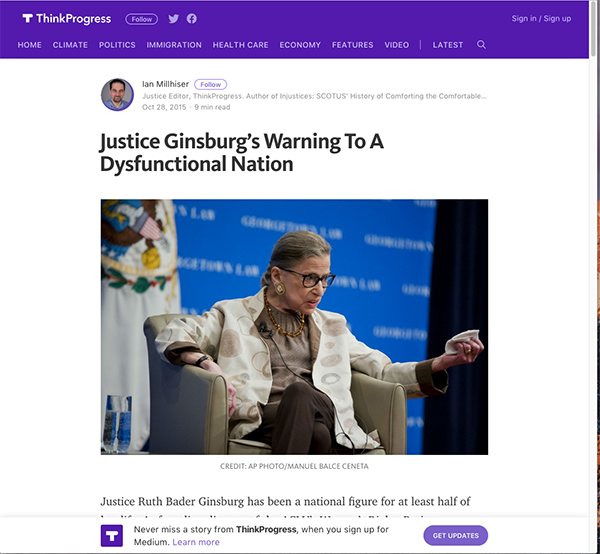
Submitted by Maxine Goulding, California Special Occasions
I read a very interesting article about the work that Justice Ginsburg has accomplished over the years and why she is so passionate about it. She gives a bit of history of how women, pay (we still only make 78% of what men make), and LGBT rights for all have
changed over time.
Justice Ruth Bader Ginsburg has been a national figure for at least half of her life. As founding director of the ACLU’s Women’s Rights Project, Ginsburg probably did more than any other litigator in the nation’s history to abolish sex discrimination and gender stereotyping. Read the full article here.
Making Wise Investment Decisions?
What’s happening in world of investments and strategies to help you make wise decisions?
Find out what the Wells Fargo Investment Institute Global Investment Strategy Report says. Download Wells Fargo Global Investment Strategy Report.

Why Words Matter: A Recap of the July Event
Guest Presenter Gary Purece
We welcomed Gary Purece as our speaker at the July 21 meeting. His topic was timely and very informative. He said that asking six key questions during any conversation with anyone would help to communicate clearly and respectfully.
The questions are: Who, What, Where, When, Why and What If. Asking these questions will cause people to feel valued. When people feel valued, they stay longer and give more to the organization.
There are two things to create through words:
- Credibility/Trust
- Decisive/Assertive
Stories are a key element in communication by using CASST which is an acronym for Central character, A complication, Setting, Series of actions, Theme. It is the way leaders talk. If you want to download his presentation, CLICK HERE.
Great Storytelling Starts with a Great Story

The May NAWBO-SV event was about storytelling. We all know how important storytelling is to build a connection with your clients and potential customers. We hear it over and over again from marketing experts. But the biggest roadblock for many of us is that we don’t’ think we have a story to tell that is compelling or will resonate with our target audience.
Our presenter, Stephanie Nivinskus, CEO, Sizzle Force Marketing, has spent most of her life storytelling — first as a journalist and then as a marketer. She told us that everyone has a story that can be developed and showed us the impact they can have. She offered two storyline strategies as samples: 2×4 Style and the Startup Story.
The “2×4 Style” is coined from the concept of a more dramatic, “hit them over the head with a 2×4” storyline that consists of 1) identifying the messy situation or issue; 2) identifying what is standing in the way of a resolution; 3) creating a hero that is going to champion the quest; and 4) stating the lesson that the hero learned through the process. It draws the listener through the story to a climax where the hero is triumphant. This could be a story about a client or project you had, or a challenge that you overcame in your business.
The Startup Story is more focused on telling your own personal journey of how and why you started your business. Many business owners have a good story for why they started their business — they are passionate about something, they had a personal tragedy, challenge or life event that sparked their entrepreneurial path. Many of these types of stories are inspirational and motivating.
There are many other types of storylines, but Stephanie stated that no matter what the story, four key elements to focus on are:
- Make your audience picture the story
- Dramatize the problem
- Introduce your own personality
- Somehow acknowledge your customers within the story
Business Owners: The Clock is Ticking — Mandatory Sick Pay Leave Starts July 1, 2015

Submitted by Judy Pearce, HR Results
Be on guard for mandatory sick leave pay! Even if you have just one employee, you need to comply with this radical change in California employment law.
The Basics: Virtually every small business owner must participate by giving all employees (including part-timers and temps) three days or 24 hours of paid sick pay per year. There is also a mandatory poster that should have been on all California employers’ walls by January 1, 2015.
You can download the poster here.
You’ll find useful Q&A’s here.
If you need any assistance locating information about the new law, please email me at judypearce@hrlegalresults.com and I will try to help.
Good Health is Profitable
By Robin Nielsen, NC BCHN®
http://www.togrowyoung.com
“There is nothing touchy-feely about increased profits.” Arianna Huffington
It’s dollars and cents vs. health and happiness. They both go together because having healthier happier employees = increased profits. The statistics are overwhelming.
Reducing stress is key to productivity and retention. Happy people generate positive energy. And healthier employees, and those who feel their company is investing in their health, are likely to be happier.
That’s why there is a lot of data that supports the profitability of health and wellness programs in the workplace. In fact, most industry studies have shown that the ROI on a well-run employee wellness program can be as much as $3-$6 for every $1 invested, with savings realized 2-3 years after implementation.
The cost not to focus on employee wellness are big numbers as well. The average health care cost per employee was about $10,000 in 2013. And when you add in the average cost for absenteeism and inefficiency that is estimated to be another $14,000 per employee. That’s on average $24,000 per employee.
Over 70% of health care spending is caused by modifiable health risks such as lack of exercise, high blood pressure, being overweight, high cholesterol, etc. These are all preventative; but unhealthy lifestyle choices can lead to chronic diseases, costing businesses even more.
The “cubicle” mentality has created lots of sedentary employees causing many health issues.
So how do business owners keep their employees motivated and engaged, healthy and happy? Employers need to make a commitment to an ongoing mindset of employee wellness.
The foundation for this mindset needs to include:
- Providing access to nutritious food and drinks
- Encourage stress reduction (yoga, meditation programs, coaching)
- Improve social connections
- Integrate exercise and movement
- Create healthier live-work balance
- Ensure employees have opportunities to learn about making healthier lifestyle decisions.
Technology Trends in the News

Adrienne Wong, TeamLogic IT of Mountain View
In 2015, it’s all about keeping your technology close and your business operations closer. Take-with-you software, security and gadgets that help you efficiently and effectively grow your business from anywhere – while protecting what you already have -are the name of the game this year. If you are looking to take the next big step with your small business, consider the following hot technologies:
Cloud Computing
If you aren’t taking advantage of cloud technology, you could be missing out on the most secure method of file storage available and the convenience of being able to access and share your files from nearly anywhere. Consider the small business-friendly, Hybrid Cloud, which offers affordable and fast disaster recovery that combines the convenience of local backup with the strength of the cloud.
Cyber-Security Protection
Stories of security breaches at major corporations dominate headlines but, according to the National Cyber Security Alliance, small businesses are far more susceptible to cyber attacks than their larger counterparts. Make it a priority in 2015 to put a plan in place to protect your business from cyber threats.
Unified Communications
With businesses depending more and more on mobile technology for working on the go, unified communications will become increasingly important in 2015 and beyond. UC integrates voicemail, email, SMS, web, desktop sharing, and video conferencing, etc. UC encompasses all forms of communications that are exchanged via a network.
SUCCESS and [A Word to Get Rid of Forever]
Submitted by: Hilary Hendershott, Family Wealth Consulting Group
I’ve been thinking about NAWBO and what it is to be a business owner.
I’ve been thinking about the big concepts like success and then, because my brain works the way it does, I think about its opposite.
There’s a word called failure. I think about this word as I watch my cat in the backyard. He is a hunter. He eyes his prey—a bird? A mouse? He watches carefully. He notices movement. He anticipates where the bird will go when he pounces.
Cats never take to the couch and bemoan their failures. Failure doesn’t exist in the cat world, and, I surmise, it doesn’t really exist in the human world either. It’s a thing that we think. (Thank you, Dr. Seuss).
Failure is conceptual. It is a made up human condition that exists in language that seems to start the emotional rollercoaster rolling. It lives, if it lives anywhere, as a word or thought. Independent of a human being trapped in culture and conditioning, it does not have anywhere to take up residence.
It certainly doesn’t belong in any NAWBO member’s vocabulary. Simply put, we made failure up—and, to make matters worse, we forgot that we made it up. We use failure as if the concept were real to bully ourselves and others. The truth is this: You’ve set out to do something. You’ve either done it or not done it. If you did it, and didn’t achieve the desired results, you simply keep calibrating to achieve your desired results or lose interest.
You don’t fail. You can’t. Failure doesn’t exist. It’s important to ponder—as failure, or the fear of it seems to keep people out of claiming the life that is available to them—the life they want. If you’ve tried saving, tried investing, tried earning what you feel you’re worth, tried being “good” at anything—well, keep trying. Or stop. Yoda says: “Do or do not do. There is no try.”
As it turns out, there is no failure either. Human beings created failure in language, and if it doesn’t serve you, you can create something else. What else would you create? What stories would you rewrite?
Secure Your Financial Information While You Vacation
Submitted by: Rashida Lilani, CFP®, CMFC®, Lilani Wealth Management
Planning a getaway for some rest and relaxation? Before you can embark, one of the “to do” items on your list should be ensuring that your financial information is safeguarded during your travels. Taking precautions and preparing for the unforeseeable may not seem as important as packing sun block or that bathing suit, but will seem like a brilliant idea in the event something does go awry.
The following is a good basic list of things to do:
- Copies, copies, copies: Make copies of your driver’s license, passport, credit cards and carry all relevant contact numbers in the event your wallet is stolen or lost. Leave a set of copies at home with a friend.
- Travel light, wallet included: I personally have trouble traveling light; especially when it comes to shoes. How can one not pack enough shoes, right? However, one thing I always make sure to do before I leave on a trip is to empty out everything from my wallet except for my driver’s license, ATM card and a couple of major credit cards.
- Use plastic: The zero-liability policy offered by most major credit cards makes it the obvious choice for payments, providing recourse in the event there is fraud or your card is stolen.
- Carry cash: As convenient as it is to use plastic, cash is still king. Not all places take credit cards and it’s a good idea to have some cash on you.
- Stay alert: Pickpockets love tourist destinations. Remember, they can tell the tourist from the regular folk; your tan and your flip flops will give you away for sure. Clean out your rental car before you return it, making sure no personal information is left behind.
There’s rarely a thing called the “perfect vacation” but you can certainly prepare. So do the best you can and have a wonderful time!